Specialists in oral translation services

Tuesday, August 30, 2022

Top ten things you need to know about ISO standards and the conference interpreting profession

 By Michelle Hof,  Aib

Earlier this year, I attended a workshop organised by AIIC Training and Professional Development that made it clear to me that conference interpreters need to know more about ISO standards and how they affect our profession. The two expert trainers, Verónica Pérez Guarnieri and Haris Ghinos, have made substantial contributions to the development of these standards through their work with ISO over the years. Verónica is the Convener of the ISO TC37/SC5/WG2 working group, made up of close to 200 experts working on the standardization of interpreting, and Haris was Project Leader at ISO TC37/SC5/WG2 for ISO 23155:2022 on Conference interpreting services (more on that in a moment). I am grateful to them for having shared their expertise with their fellow interpreters at this training event.

There is a lot to learn about the role that ISO standards can and should play in our profession – far more than can be covered in a short blog post – so let’s just focus on the top ten practical takeaways from the training event I attended.

1. The first, and perhaps most important, lesson to be learned is that there are actually ISO standards that apply to our profession. A lot of interpreters aren’t aware of this. Here is a list of the most relevant ones, in the order that they were published:

ISO 13611:2014 Interpreting – Guidelines for community interpreting
ISO 18841:2018 Interpreting services – General requirements and recommendations
ISO 20228:2019 Interpreting services – Legal interpreting – Requirements
ISO 21998:2020 Healthcare interpreting – Requirements and recommendations
ISO/PAS 24019:2020 Simultaneous Interpreting Delivery Platforms – Requirements and recommendations

2. The conference interpreters among us may have noticed that conference interpreting isn’t specifically referred to in the list above. My second important message for readers is that, as of January 2022, there is now a specific standard just for conference interpreting:

ISO 23155:2022 Interpreting services – Conference interpreting – Requirements and recommendations

3. Let’s unpack that last point a bit. It may not look like much, just a series of numbers, but ISO 23155:2022 offers a wealth of information. It includes sections with general provisions about conference interpreting, requirements and recommendations applicable to conference interpreters in connection with conference interpreting assignments, and requirements concerning the conference interpreting service provider. It also contains a series of annexes describing a typical conference interpreting workflow, a sample code of conduct, the content of an assignment agreement, a description of customary practice when recruiting conference interpreters, and more.

4. ISO 23155:2022 also contains a number of useful definitions of concepts related to language, to parties involved in conference interpreting and modes of interpreting, and to conference interpreting equipment and settings. Just to give one example: for what I believe is the first time, the term “conference interpreting” is defined. The definition states that conference interpreting is “interpreting used for multilingual communication at technical, political, scientific and other formal meetings”. So the next time somebody tells you that the task of the conference interpreter is impossible to describe or explain, you can point them to the ISO definition!

5. Another interesting definition to be found in ISO 23155:2022 is that of Conference Interpreting Service Provider or CISP, which, as Haris explained to us during the training, is a role meant to cover individual conference interpreters, groups of conference interpreters, consultant interpreters, language service providers, government departments, international organizations, and more. If you fall into one of these groups, it is worthwhile seeing how this definition is covered by this ISO standard, as it may help you – and your client – better understand your task.

6. You need to purchase ISO standards to be able to consult the full text and quote them in contracts or tendering procedures. They can be purchased online at the ISO store. However, anyone can access a free preview of any ISO standard containing the Foreword, Introduction, Scope, Normative references, and Terms and definitions. The free preview for ISO 23155:2022 can be found here.

7. It’s worth noting that AIIC members can access the full texts of relevant ISO standards, including the ones listed above, on the Association’s intranet. Other professional associations may have negotiated access for their members, so if you belong to another association, you may want to check it out.

8. Conference interpreters, in particular those who run companies or work as consultants, should think about getting certified for ISO 23155:2022. It will take some time and resources to obtain certification, but it is worth the effort. There are also other ISO standards for which companies or consultants may wish to obtain certification, including ISO 9001 on quality management.

9. Conference interpreters can contribute to the ISO standard drafting process. You can do this through your national standardisation bodies. You can’t join as an individual, but you can represent a company, association, organisation or educational institution (note that there are fees involved).

10. To find out more about how ISO works, there are plenty of free resources available. You can, for instance, learn more about the Language and Terminology Technical Committee and its subgroups and working parties, including the one that deals with interpreting. You can find out about the Stages and resources for standard development . Also, ISO maintains an Online Browsing Platform where you can consult ISO terms and definitions, preview standards before you buy, search within documents and more.

This was just a quick overview of my main takeaways from last spring’s training on ISO standards for conference interpreters. I strongly recommend you take some time to find out more about how ISO standards can affect our profession – and if you can attend another event with Verónica or Haris to get the information from the horse’s mouth, then all the better!

Sunday, July 17, 2022

SLUG LINE… ¿EL RASTRO DE LA BABOSA?

Por Fernando González, AIB


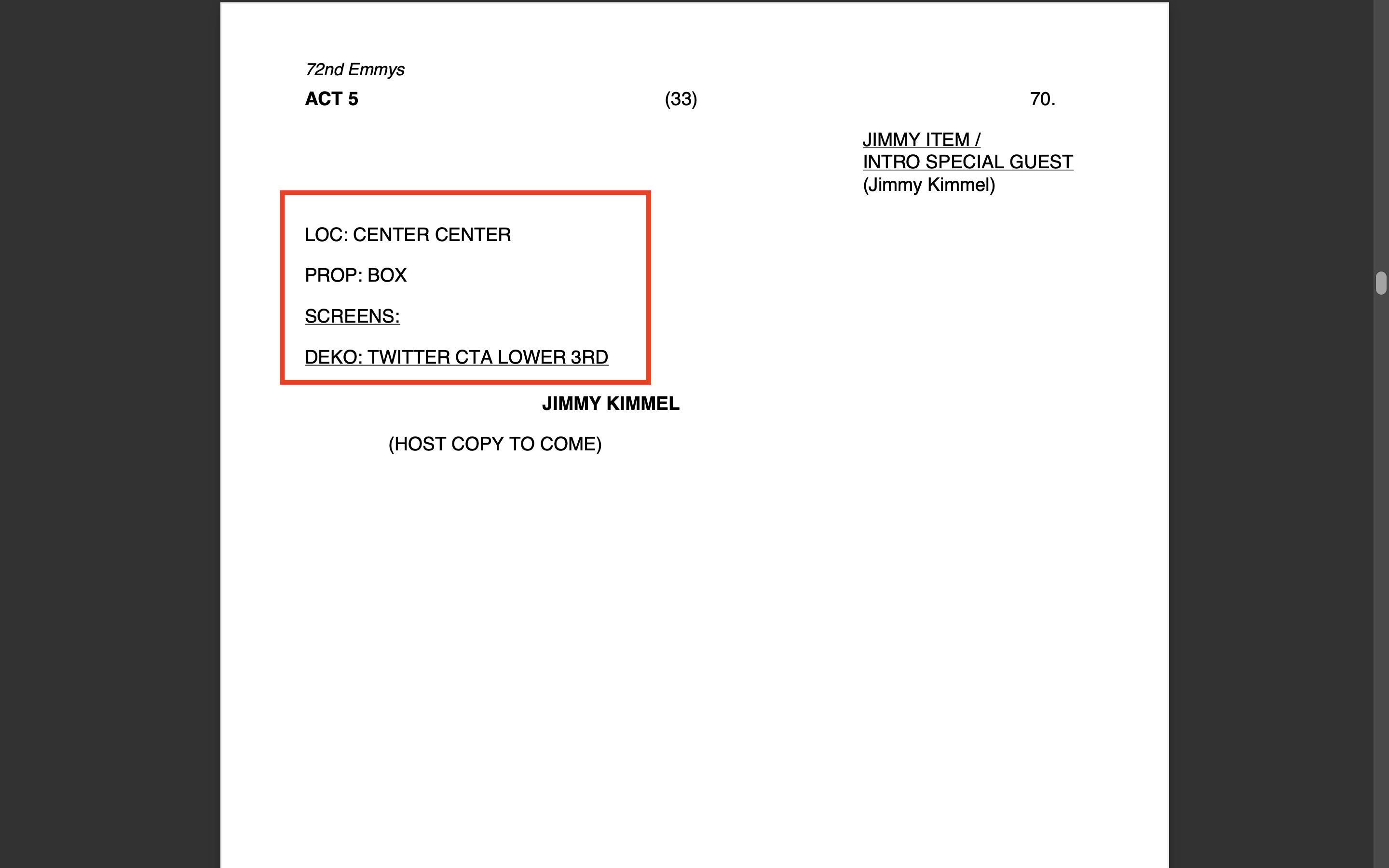
Tras muchos años interpretando para televisión premios, galas, festivales, etc., confieso que me costó darme cuenta de importancia y significado de los “slug lines” (SL en adelante) en los guiones.

SL es la información que aparece en MAYÚSCULAS en cualquier guion y que ayuda a entender todo lo que ocurre en el escenario, plató, etc. Pueden ser indicaciones para los presentadores/actores o información técnica para los miembros del equipo sobre ubicación, escenografía, iluminación, audio, video, attrezzo, grafismo. El origen del término es incierto, pero según parece…

A "slug" is essentially a blank. It's the blank circle of metal used in making coins. Also, a blank used in typesetting. But in a wire service article, the "slug line" that identifies the article occurred in the space where the "slug" or space would be in a print version. So, a slug line came to mean a short description - often a title - for a news item. It was so you could quickly scan the tape and find a story that interested you. This goes back to the 20s and 30s. You've probably seen the earliest "scripts." They were just slug lines for a series of scenes.

Tradicionalmente los SL en guiones de obras de teatro o de películas aparecen siempre en mayúsculas al principio de cada escena y describen la ubicación y momento del día.

Ejemplo: 

INT. JIMMY'S BEDROOM - NIGHT

Por lo general, los guiones se escriben conforme a unos patrones y un formato comúnmente aceptados para producciones que requieran el uso de varias cámaras:
1. Están escritos en formato carta (letter), también conocido como ANSI A, formato de folio habitual en EEUU. Un poco más bajo y más ancho que el DIN A.
2. Los guiones tienen un margen de una pulgada a la izquierda para unir las páginas con anillas o canutillos en caso de necesidad
3. Todo guion cuenta con un margen de tres a cuatro pulgadas a la derecha para tomar apuntes.
4. Se pueden usar minúsculas y mayúsculas, salvo las indicaciones que van siempre en MAYÚSCULA.
5. La numeración de las páginas va siempre en la esquina superior derecha.
6. Cada página incluye el número de cada segmento del programa en la esquina superior izquierda o en el centro.
7. El espaciado de los renglones es siempre doble.
8. Las revisiones constan en cada nueva página con fecha y hora. Cada nueva revisión se indica con un color diferente de página. El orden de colores de las revisiones es el siguiente:
1. Blanco (la publicidad azul)
2. Rosa
3. Amarillo
4. Verde
5. Dorado
6. Salmón
7. Gris
8. Fucsia

Los intérpretes también recibimos el guion con cierta antelación. Si bien no conviene hacerse demasiadas ilusiones, ya que, por desgracia, no todos los diálogos están siempre en el guion. Por ejemplo, los monólogos del maestro o de la maestra de ceremonias no suele incluirse. En ese caso, el lugar del texto lo ocupa un lacónico “TO COME”. Y, claro, la sensación de estar al borde del precipicio es muy intensa cuando, por ejemplo, el maestro de ceremonias es Ricky Gervais y todo lo que pone en el guion es

RICKY GERVAIS:
TO COME

RICKY GERVAIS: 
AD LIB

En esos casos sabes que te tienes que agarrar porque vienen curvas. Ese “TO COME” es la constante promesa incumplida.

En ocasiones, los SL ofrecen una información más valiosa que los propios diálogos.

Cuántas veces me ha sorprendido el maestro de ceremonias iniciando su monólogo fuera de cámara o fuera del escenario mientras yo esperaba que apareciera en el centro del escenario perfectamente iluminado por los focos. Otras veces aparece alguien con un disfraz tan loco y desconcertante que tardas unos segundos en reaccionar cuando empiezan a hablar. Incluso te sorprende ver a alguien dialogando con personajes de dibujos animados o creaciones de CGI que el público que asiste a la gala no ve pero que sí aparecen en la pantalla.

En todos estos ejemplos, la información contenida en los SL te permite estar prevenido para no quedarte in albis.

A lo largo de los años he ido compilando el significado de algunos acrónimos, que ofrezco a continuación por si pudieran ser de utilidad para alguien que se disponga a interpretar con un guion de TV en la mano.

M.O.S.: significa “sin audio”. Cuenta la leyenda que un director de origen alemán (acaso Josef von Sternberg, quien descubrió a Marlene Dietrich) quiso rodar una escena sin sonido y ordenó al equipo que rodaran "mit out sound", lo cual hizo mucha gracia a los miembros del equipo y empezaron a usar la expresión hasta que se popularizó en el mundillo del espectáculo. 

S.O.F.: significa “Sound On Film”, o sea, que sí hay audio.

VIDEO OUT-Q:  Out-Q es lo último que aparece en plano en un segmento. Sirve de pie para el siguiente segmento. 

O.C./O.S.: Off-Camera/Off-Screen. Acrónimo que aparece a veces junto al nombre del personaje antes del diálogo. Quiere decir que el guionista desea específicamente que se oiga la voz, pero no se vea al protagonista.

SFX: Abreviatura de Sound Effects.

SPFX: Abreviatura de efectos especiales.

SMASH CUT: Un rápido cambio de un plano a otro. 

SPLIT SCREEN: En una pantalla aparecen escenas diferentes, normalmente interactivas, como dos personajes que mantienen una conversación telefónica y aparecen ambos en pantalla.

STAGE CENTER: Más comúnmente conocido como CENTER STAGE. Generalmente el centro del escenario o del plató, donde se suelen colocar los actores.

V.O.: indica que el que habla narra la acción fuera de pantalla. Voz en off.

WGA Signatory: Es cualquier agente, productor que ha aceptado cumplir las condiciones impuestas por el colegio de guionistas de EEUU (the Writers Guild of America).

OFF: Abreviatura de offstage. Se suele poner (off) al lado del nombre del personaje en cualquiera de los dos supuestos anteriores.

B-ROLL: La edición A/B roll puede ser muy variada según la cortinilla empleada. Una consiste en que la imagen A se superpone paulatinamente a la otra, esto se conoce como encadenado o transición. Otra muy habitual es que la imagen existente vaya oscureciéndose o aclarándose hasta quedar totalmente negra o totalmente blanca, efecto conocido como fundido (fade to black/White)

EZ NEWS: El software que se suele usar en las redacciones de las cadenas de TV. Permite crear escaletas, redactar noticias para reportajes, imprimir guiones, sacarlo por el teleprompter. Todo en el mismo servidor.

NATURAL SOUND: también conocido como Nat Sound, Nat S-O-T. es el sonido ambiente. Voces, música, tráfico o cualquier sonido de entorno que se graba in situ para posteriormente crear sonido de fondo para la conexión en directo. Se usa para crear ambiente, pero resulta cansino cuando se abusa de él. 

PACKAGE (PKG) (o Donut): reportaje pregrabado que necesita presentación por parte del presentador. 

SOUND BITE/SOUNDBITE (SOT): Totales. Fragmento editado de un reportero hablando. Pueden ser varios SOT montados uno tras otro y se pueden incluir en PKGs y VO/SOTs o ir aislados. 

VOICEOVER (VO): Una noticia para TV en la que el presentador o el corresponsal o reportero leen en directo un guion mientras se muestra un video pregrabado en pantalla. 

Voiceover-to-sound(VO/SOT): igual que el anterior pero al final del SOT el presentador reanuda su locución con o sin video añadido en pantalla. 

FOLEY: Efectos de sala. Son aquellos efectos que buscan la recreación de sonidos que por diversos motivos no fueron recogidos en el momento de la grabación de la escena. El término foley debe su nombre al neoyorquino Jack Foley, quien desarrolló muchas de las técnicas que ahora se usan en esta fase de la producción sonora.

VO-SOT-VO (o VO-SOT/TAG) (Voice Over Sound on Tape)

Pieza leída por el presentador o reportero acompañado de un video a pantalla completa. Al video le sigue uno o varios totales (soundbites).

“Package (PKG): Es la típica pieza que manda un corresponsal o reportero que, tras dos o tres frases en V.O. de éste, incluye los denominados totales (soundbites); imágenes de declaraciones que realiza un personaje ­–o cualquiera que pase por allí– con una duración que por lo general no supera los 10 segundos y que están situadas a lo largo de una noticia. Las informaciones que forman un telediario por lo general incluyen varios totales y estos a su vez pueden situarse unidos o separados entre sí. 

VO/SOT: Voiceover-to-sound Un VO/SOT puede recibir varias denominaciones. A veces V.O. bite, otras VOB, o incluso VObite o VObyte. Es un guion leído en directo por el presentador. Mientras éste lee, se muestra un video. El presentador deja de leer en un momento dado para que pinchen un video con una entrevista. Normalmente los VO/SOTs duran entre 30 y 45 segundos. El total incluido en la pieza dura entre 10 y 15 segundos. 

WALLPAPER: imágenes genéricas o video pregrabado que se usan de relleno (recurso muy molesto en programas con tertulianos en que se muestran imágenes en bucle mientras los tertulianos hablan o discuten). 

CHROMA KEY (AKA GREEN SCREEN): Sistema electrónico para producir efectos en televisión; efecto especial que consiste en incrustar una imagen en el área ocupada por un determinado color.

FEED: transmisión por satélite de un PKG, reportaje o documental. 

M&E: Music and effects: si hay música y sonido natural (efectos), irán por el canal dos, salvo indicación contraria, como en el caso de MIX. 

MIX:  Si la transmisión indica que el canal 1 está mezclado con el canal 2 que contiene M&E, significa que el canal 1 incluye todo el audio (VO, entrevistas, totales, sonido de fondo y M&E.  El canal 2 incluye todo salvo el VO.

NARRATION: La voz en off en un video. El guion debe indicar si la narración es en inglés u otro idioma, así como el idioma original de los totales. 

NAT SOUND: El micrófono capta el sonido ambiente del entorno.

SLATE: Cartel informativo o “claqueta”. Las inserciones de texto que aparecen en la cabecera. Identifica el título de la historia, duración, tiempo total de la pieza y nombres y cargos de las personas que en ella aparecen. 

CLEANFEED: versión de una pieza limpia de inserciones de texto. Tiene que tener exactamente la misma duración que la misma pieza con inserciones de texto. 

T TRACK, sinónimo de canal.

TRT: Total Running Time. Se refiere a la duración total de la pieza tras montaje. 

SIMULCAST: Transmisión de la misma señal por dos medios de transmisión diferentes. Por ejemplo, transmisión por satélite y transmisión por Internet. O también se considera simulcast la transmisión por el mismo medio de dos servicios diferentes como por ejemplo dos audios de la misma película, uno en versión castellano y otro en versión original.

WEBCASTING: Se refiere a la difusión de contendidos audiovisuales a través de la World Wide Web. 

DIRECT-TO-HOME: Se refiere a la transmisión de señales de radio desde un satélite directamente al domicilio del usuario, por medio de una antena parabólica de pequeño tamaño. El servicio DTH más popular es la televisión por satélite.

TITLES: Rótulos o rotulación. Identificación de toda persona que aparece en una pieza. Se incluyen en el cartel informative o claqueta. 

Siglas para instrucciones para los camarógrafos:

ELS: extreme long shot 

MLS: medium long shot 

LS: long shot 

MS: medium shot 

MCU: medium close-up 

CU: close-up 

ECU: extreme close-up 

OS: over-the-shoulder shot 

POV: point of view shot 

ZI /ZO: zoom in /zoom out 

PAN: movimiento de la cámara de arriba abajo o viceversas o de izquierda a derecha o viceversa

INT: interior 

EXT: exterior 

SOT o SOF: sound on tape or sound on film

BG: background 

SFX o F/X: special effects (can be either sound or visual) 

VO: voice-over 

OSV: off-screen voice 

DIS: dissolve. Fundido.

MIC: microphone 

VTR: cinta de video 

ANNCR: announcer 

SUPER: superimposition

Otro aspecto digno de mención en las galas son las actuaciones musicales. El guion especifica de qué tipo de interpretación musical se trata: 

1. LIVE: El/los artistas cantan sin fondo musical pregrabado, acompañados por uno o más instrumentos o incluso una orquesta. 

2. LIVE-TO-TRACK: Cantan en directo pero la música proviene de una banda Sonora pregrabada y mezclada.

3. LIP-SYNC: Lo que en España se ha llamado “Playback” de toda la vida. Cantan como si de verdad estuvieran interpretando la canción, pero el audio (incluyendo la voz) está pregrabado y mezclado. Es decir, no se limitan a mover los labios, ya que la actitud y postura corporal no parece natural y la respiración no es igual de natural que cuando se canta de verdad ni la energía necesaria para sostener una nota es la misma. Produce la misma impresión que cuando vemos a un actor cargar con una maleta vacía. El esfuerzo no es el mismo que cuando la maleta está llena, y se nota.

A continuación, dejo algunos ejemplos de slug lines, por si queréis entreteneros en descifrarlos.


Si os interesa el mundillo de la TV, aquí os dejo un libro sobre la producción de programas. 


Thursday, June 23, 2022

¿SIMPLIFICACIÓN SIMULTÁNEA?

Por Myriam Nahón Guillén, Intérprete de Conferencias, AIIC 

Una nueva modalidad de interpretación de conferencias

Hoy tengo el placer de darle la palabra a nuestra colega Myriam Nahón para que nos explique en qué consiste la “simplificación simultánea”, una nueva modalidad de interpretación que tiene como objetivo facilitar la vida a las personas con discapacidad intelectual.

Myriam Nahón se formó en el SCIC en 1991. En 1996 pasó a trabajar como intérprete freelance y volvió a Madrid, donde entró a formar parte de Espaiic. En 2010 se mudó a Israel y siguió trabajando como intérprete freelance. Actualmente es miembro de la Junta de Israiic y representante de la Región Israel en el Consejo Asesor de AIIC. Se topó con la simplificación simultánea en 2017 y desde el primer momento la enganchó.

Cristina Amils, AIB


¿En qué consiste la simplificación simultánea? 

La simplificación simultánea es una forma de interpretación mediante la cual ponemos a disposición de las personas con discapacidad intelectual los discursos y presentaciones de las conferencias. Puede ser de una lengua a la misma lengua simplificada o de una lengua a otra lengua simplificada. Nuestro público son las personas con discapacidad intelectual o deficiencias cognitivas, ya sea de desarrollo, resultado de un derrame cerebral, un accidente o el envejecimiento. Este ejercicio también puede beneficiar a los inmigrantes que aún no dominan una lengua local.

No es tan fácil como parece...

Además de la carga cognitiva que requiere la interpretación simultánea, el ejercicio de la simplificación simultánea requiere un mayor procesamiento para determinar lo que se mantendrá y lo que se descartará, formulando un mensaje inteligible y transmitiéndolo con el mayor respeto y sin una pizca de condescendencia.

Pioneros de esta nueva modalidad de interpretación

Desde el principio nos hemos esforzado por enmarcar el desarrollo de esta nueva modalidad de interpretación en el contexto de AIIC para que se apliquen las mismas normas profesionales. Lo hemos hecho a través de Israiic, la asociación que representa a la región Israel. Según nuestra experiencia, además de la parte que compete a la interpretación de conferencias, es fundamental desarrollar la simplificación simultánea en cada país en colaboración con las entidades que trabajan directamente con el público destinatario y que conocen sus necesidades, así como con el ámbito académico que suele establecer las normas de simplificación escrita y oral.


La simplificación simultánea en España

La simplificación simultánea no existe en España… todavía. Existen normas de simplificación aplicadas a la lectura, llamada “lectura fácil”. Esperamos que esta primicia mundial encuentre eco en España a través de Espaiic. Y dado que consideramos fundamental trabajar con las entidades que defienden los derechos de las personas con discapacidad intelectual, nos hemos puesto en contacto con la organización Plena Inclusión, que es la confederación de asociaciones que apoyan a las personas con discapacidad intelectual, y a través de ellos, con la Fundación ONCE, con la que esperamos desarrollar un proyecto que nos permita a final de cuentas prestar el servicio de simplificación simultánea en España.

Nuestro objetivo

Esperamos que esta forma de accesibilidad se convierta en la norma y no en la excepción en el marco de la igualdad de derechos de las personas con discapacidad. Nos esforzamos por concienciar a las instituciones públicas y a la población en general sobre la actual falta de accesibilidad para las personas con discapacidad intelectual, a pesar de que representan el mayor porcentaje dentro de la población con discapacidad. Nos llena de satisfacción prestar un servicio que permite a las personas con deficiencias cognitivas participar en igualdad de condiciones en conferencias, intercambios, emisiones de televisión y cualquier evento de su interés.


Esperamos tener la oportunidad de presentar a todos los miembros de Espaiic nuestro proyecto en un próximo futuro y así explicar con más detalle nuestra experiencia, así como responder a todas vuestras preguntas. Estaremos encantados de compartir nuestra experiencia con quienes estén interesados en desarrollar la simplificación simultánea en España. 

Agradezco a AIB la oportunidad de dar a conocer la simplificación simultánea mediante este blog y en particular a Edwina Mumbrú por su disponibilidad para asumir la coordinación del proyecto en España.

Myriam Nahón Guillén
Intérprete de conferencias
Miembro de AIIC

Wednesday, May 18, 2022

Gelato with Jenny Fearnside, AIIC's new president

By Catherine Sherry, AIB

AIB. How did you get into interpreting? 

Jenny Fearnside. I’d wanted to be a doctor until the night before I had to choose my A-levels, when I suddenly decided to study languages and become an interpreter. I have no idea why! My aunt had a friend who worked at the European Commission, maybe it was that. I didn’t really know what interpreting was about but was keen for a challenge. After that, I was given a place to do a BA in French and German Translating and Interpreting at Herriot-Watt University in Edinburgh, so I did a gap year in Rome beforehand to learn Italian too. It was the best thing I ever did! As soon as I graduated, I went to the Commission and joined the staff there.

What do you do to unwind? 

I’m into a lot of sports - cycling, rowing and running, but only outdoors. I don’t own a car in Rome but I do have a kayak! I also enjoy travelling and some of my indoor pursuits are knitting, sewing and cooking.

Any interpreting anecdotes? 

Yes, the infamous Norman Wisdom [a famous British comedian of the 1950-60s] moment! I was working at my first Council of Finance Ministers in Brussels and was getting very peckish as lunchtime approached. Just before we broke, a French-speaking representative of the Commission took the floor and announced that the following year, all budgetary spending would have to be in the hands of “la sagesse Normande”. Blood sugar levels were low and without thinking I interpreted this as “in the hands of Norman Wisdom”, which caused some guffawing in the room. At lunchtime the UK minister came up to me and said, “You’re THE English interpreter, right? Norman Wisdom was my hero as kid, that was brilliant!” 

He must have mentioned it at the Press Conference because the next day it was all over the British press! 

When and why did you join AIIC?

I joined when I was on the staff at the Commission. Back then we would go into the booth without knowing when we’d get out - sometimes even the next day. So I wanted to find strength in numbers and to ensure decent working conditions.

What inspired you to run for president?

Four years ago, I became vice-president by accident really, because I’d gone to the Assembly in Valencia at the last minute when an option I had was cancelled. It turned out that new candidates were suddenly needed and when I met Uroš [Peterc, previous president], I said if you run for president, I’ll run for VP. 

Towards the end of that mandate, a few people suggested me going on as president. I’m not particularly political and I would rather stay under the radar than be in the limelight, but I knew by then that I could do the job and it made sense for there to be continuity rather than a whole new team starting from scratch. Also, the pandemic meant that in the last mandate we had little scope for moving AIIC’s agenda forward because we were so busy dealing with external factors, so this is an opportunity to do what we have planned rather than what we are forced to do.

How have the first four months gone?

It’s been extremely busy! But now that we’ve got projects underway it’s exciting because it will streamline and modernise AIIC, shake things up a bit. 

A core feature of the strategic plan is to set up an AIIC Foundation, which would be free of the current tax-related constraints of AIIC’s not-for-profit status. This means that our training – one of AIIC’s big successes - can be professionalised and we can provide consultancy. Some of the profits can then be ploughed back into the association to fund further activities or cover some of the secretariat’s costs, for instance, which might have a knock-on effect on dues.

We’re also considering holding the AIIC Conference yearly, depending on how the first one next year goes. In a nutshell, AIIC is starting to look more outwards. Nobody is going to come to us; we need to go out and establish ourselves, not just as an add-on but as one of the main players. 

How do you see the future of interpreting?

Remote interpreting is taking multilingualism to places previously not possible because of travel and cost limitations. Since the pandemic, meetings with simultaneous interpretation can be organised at the drop of a hat.  

I don’t see this as the end of the line but just as a different line. We need to be flexible and set red lines on health and safety and working conditions, but also to allow for and actually shape new developments by demanding the right conditions. 

AIIC was very well placed to do this at the start of the health crisis and a lot of institutions came to us for assistance and guidance because we’d showed foresight in already researching remote interpreting. We have to keep this up because things are developing thick and fast. Either we’re involved in creating this new environment, or we’re out in the cold and can only accept or refuse it. I believe we have to be in there.

If you had one wish for interpreters, what would it be?

That their careers are as satisfying as mine has been. Things have changed and will continue to, but I hope the satisfaction remains. For me personally, to retire graciously. I hope I’ll know when the time comes! When it does, I hope to live by the sea and take up winter swimming, in Greece perhaps, and volunteer and do all my other activities.

Are people treating you differently now that you’re the president? 

Colleagues jokingly doff their cap to me and that sort of thing! But as I say, I just want to do the job. Some of the work isn’t necessarily visible yet as it’s more about channelling the direction of AIIC. 

I was treasurer in Greece & Cyprus, and there’s nothing like being involved to see how it all fits together and bring influence to bear on the image of the association. You get to meet far more colleagues than just your boothmates, and colleagues volunteer for the assembly for example from all over the world, which is fabulous. 

As a low-key person myself, I really want to hear more of the low-key voices. There is not a single member of AIIC who doesn’t know enough to have an opinion. Everyone has the right to have their opinions heard and if people are reluctant to voice them publicly, I would really love them to approach me personally.

j.fearnside@aiic.net

Wednesday, April 20, 2022

Changing, Updating and Adapting – A checklist for speakers

By Mary Fons I Fleming, AIB

It’s been a while since I last wrote for this blog, and we’ve learned a lot in the intervening period: among other things, that most headsets with boom mics are not the ideal solution for interpreters or speakers.

As a result, we’ve had to update the advice we give our speakers. We used to tell them to use a headset, but many were reluctant to use them, even when issued by their employer, apparently because, the claim goes, “it makes them look like call center operators”. Fair enough. Other speakers didn’t get the difference between a wired headset and wired phone earbuds (“But my earbuds have a microphone, see?”). And many fail to see that there really is a huge gap in quality between the omnidirectional mic right there in their laptops and the kind of cardioid or supercardioid mics that we need them to use (“But no one has ever complained!”). The message that headsets are not the end-all and be-all hasn’t yet reached all conference interpreters, so it’s hardly a surprise that speakers have trouble figuring things out.

The fact is, as long as the organizers of a meeting are not prepared to send every remote speaker the right kind of microphone for their setting and provide the right kind of on-site or off-site technical support, interpreters will still be dealing with bad sound, at least part of the time, and the ensuing need to either stop interpreting or put their hearing at risk.

AIIC has done a great job of producing a simple set of tips for remote speakers (found under Item 24 on the website’s Guidelines page, in 16 languages by my current count), but speakers (and interpreters!) still need a little more guidance than that.

If I were a prospective speaker at an engagement with remote simultaneous interpretation and I were trying to comply with most of the advice available out there, including what’s in the guidelines, I would find myself at a loss. If I already have a headset or a microphone, is it “quality”?

As an interpreter, over the past year I have learned that a wide frequency response that is tailored to music can be as troublesome for interpreters as too narrow a response, because all it does is introduce noise that is extraneous to human speech. This goes for both the speaker’s microphone and my headphones. And I have also learned of the importance of a flat frequency response curve within the ISO-stipulated 125-15,000 Hz range, meaning that all frequencies are picked up more or less equally. 

As the speaker, I will assume (or hope) that the platform is able to carry the full ISO range provided by the mic I select (not always the case). So, back to my speaker’s quandary: if it turns out I have to do some shopping, what should I choose? And what if I buy something recommended and it doesn’t work on the day of the event? (This happens, out of the blue, with the best of equipment. The more you speak, the more likely this is to happen to you at some point.)

Right now, in early April 2022, if a remote speaker asked me what to buy without breaking the bank, unless the speaker is forced to speak from somewhere absolutely cavernous with zero options to dampen the sound, I would suggest either a standalone supercardioid USB condenser mic, preferably mounted on a boom arm, or a lapel mic plus a sound card, and I would suggest a few specific models which appear to generally work well. While I know that some experts are starting to look at inexpensive dynamic USB mics, I would rather wait for their feedback on results before I start recommending anything, although I’ve been eyeing what’s available. I would also suggest a very, very long, flat Ethernet cable to run through the house, if their computer is not close enough to their router for a regular Ethernet cable.

Beyond equipment, if remote speakers have no on-site tech support available (where “tech” includes a bit of audio and bit of IT), then someone who is either in the meeting or available to meeting participants should know how to remotely troubleshoot different kinds of microphone on different operating systems and, if necessary, try out two or three different available solutions.

I would also recommend the following checklist (some of my readers already know me as a fan of checklists!):

REMOTE SPEAKER CHECKLIST

Early sound test:

  • Unless you regularly speak using remote simultaneous interpretation on the same platform you will use for the event, ask if an early sound test is possible several days before the event, even if the organizer doesn’t suggest one. This will give you time to find solutions, if need be.
  • Follow the same steps listed below.
  • Make sure you get interpreter-oriented feedback about your sound. Online conference technicians vary in terms of their sensitivity to sound issues and to interpreters’ needs, and some of them are satisfied as long as they can hear your voice. Ask, “Will this be good enough for the interpreters? Is my sound ‘clean’?”
  • If appropriate, check that you can take part in a discussion where you need the interpreters to understand some other speakers.

Day before:

  • Update computer operating system the day before the event – or ensure that updating is postponed beyond the meeting time.
  • Update all browsers or apps required for the videoconference (if more than one browser is allowed, make sure they are all up to date).
  • Finish any presentations and make sure the final version reaches the interpreters, one way or another.
  • If you don’t have a powerful computer or a very good connection, agree with the meeting hosts for someone at their end to share your slides.
  • Save any required links as shortcuts in the computer you will be speaking from.

At least an hour before the event:

  • If you know how, restrict computer startup apps to the items you will need during the event. Don’t do this for the first time ever just before a live event, though.
  • Make sure the computer is connected using an Ethernet cable and then, bravely, disconnect the Wi-Fi. (This is because Wi-Fi has a way of taking over the connection and is inherently less stable than Ethernet: your voice can wobble even with a great Wi-Fi connection.)
  • Test your connection speed and make sure it matches the platform recommendations (not just the bare-minimum requirements).
  • Reboot the computer you will be speaking from, and don’t open any applications on it that are not absolutely essential to your talk.
  • Disable or pause all backup and cloud storage apps.
  • Test that the computer recognizes your microphone as well as whatever device you are using to listen to the audio (we recommend headphones during any interactive session, but you might prefer a loudspeaker the rest of the time).
  • Put the computer in Do Not Disturb (MacOS) / Focus Assist (Windows) mode so your computer won’t be pinging at your audience.
  • Ensure a quiet environment: send the family and the dog out for a walk, banish them to the farthest end of the house, ask colleagues to leave their conversations for some other time or place, disconnect the doorbell, take the phone off the hook, mute your cell phone… whatever it takes, except for one thing: don’t let the kids download movies or play high-resolution online games while you’re speaking.
  • Join at the time requested by the organizer and follow any instructions received regarding screen names (this is important so that you are assigned the proper role). When you are asked for a sound test, say at least three sentences, preferably ones with plosives (especially “p” sounds) and sibilants (“s” sounds). Introducing yourself or your presentation works fine. Check that the interpreters are being consulted about your sound quality.
  • Do use headphones to minimize echo during any discussion period, both before and after your main talk.
  • Check that you can hear the interpreters if you need them for questions or for other speakers.
  • Make sure your face can be properly seen on camera, especially your lips. Adjust lighting and camera angle if need be.
  • If there is a lot of interaction in more than one language, allow enough time for the interpreters to switch their incoming and outgoing languages. If it’s a multilingual event (rather than just a bilingual one), it can take a bit longer for everyone to sort it out.
  • Do give the interpreters any feedback you may have at the end of the meeting. And if there’s a pressing issue during the meeting (e.g. a term you want translated differently), you can point it out when speaking or you may be able to tell them or the organizers via the chat function.

Friday, March 18, 2022

"¿Qué es mojo?"

 Por Patrícia Lluch, AIB

Vale la pena escaparse aunque sea durante cinco minutos de la realidad incierta en que vivimos y por ello he decidido que este artículo para el blog de AIB verse sobre dos cosas que me encantan y me hacen feliz: la interpretación y los gatos.

He hecho una pequeña encuesta espontánea entre los socios de AIB y resulta que del total de dieciséis, ocho tenemos o hemos tenido gatos; y que la población actual de gatos en AIB es de siete, que no está mal. También podemos ofrecer perros, peces, gallinas, un pavo, un conejillo de indias y, sorprendentemente, una perdiz (!).

Guiomar con Gris y Nala, alegres destructores de árboles de Navidad.

Seguramente todos hemos visto en estos dos años de pandemia a algún colega ante el ordenador, en plena sesión de Zoom, intentando ver la pantalla por encima del lomo del gato que en ese momento -cola enhiesta y pecho henchido- está pasando revista, cual pequeño Alejandro Magno en Asia Menor, a ese metro cuadrado de su territorio. 

Catherine con Parker, asistente asiduo a todas nuestras reuniones por Zoom. Te echamos de menos Parkie, esperamos que seas feliz en el paraíso de los gatos.

Eso antes de caer lánguidamente desmadejado encima del teclado, por supuesto. Confieso que, en mi caso, después de arduas negociaciones y alguna mirada tipo "mala madre" el compromiso suele ser que les dejo echarse detrás de la pantalla. 

Leo, uno de los míos a punto de conseguir la hazaña de hacer croquetas por encima de dos (!) teclados al mismo tiempo.

Recomiendo encarecidamente a cualquiera que se esté planteando adoptar un gato (o mejor dos) leer el libro "Total cat mojo" de Jackson Galaxy. El subtítulo es "The ultimate guide to life with your cat", y realmente lo es. ¿Queréis saber cómo razona un gato, por qué hace lo que hace y cómo prevenir o resolver los problemas de convivencia más habituales? Este es el libro que os conviene. Alternativamente, también podéis recurrir al blog del mismo autor.

Aprovecho para agradecerle a Courtney Dolliver (Senior Partner de CC PR, Los Ángeles) que en nombre de Jackson Galaxy me haya dado permiso para citar textualmente un pasaje del libro. En él se relata una situación muy incómoda que se produjo en un evento público en Argentina, para el cual alguien consideró que sería mejor contratar a una presentadora bilingüe que a un/a intérprete. Pésima idea. Así describe el autor la situación:

"I am in front of a large and very enthusiastic audience in Buenos Aires, while on a tour of Latin America. Over the course of the year, I've adjusted to speaking with a translator in places like Malaysia and Indonesia, and I had just been in Bogotá and Mexico City. If you can have simultaneous translation, with the audience wearing headphones, it is a blessing beyond belief, because the audience is with you -the laughing, gasping, and applauding happens (one hopes) just a second or three later than with an English-speaking crowd. In the big scheme of things, it's a minor inconvenience.

"But when you and your translator switch off (you finish a full thought before he begins), well...it's just a massive headache at best, an absolute kamikaze mission at worst. My translator would stand next to me, a ghost dodging my physical outbursts and stream-of-consciousness rants. The more excited I get, however, the less I remember to heed the presence or the needs of my "ghost". Some translators, the ones who pride themselves as practitioners of a linguistic art form, allow me to get an entire paragraph out of my mouth before tapping me on the shoulder or giving me that sideways glance, in order to succinctly and with equal fervor catch the audience up.

"On this night in Buenos Aires, my translator isn't that person. She is actually a newscaster who happens to be bilingual. It is not the most graceful dance that's for sure. There is much in the way of toe stepping on both of our parts.

"Improvisation aside, I always introduce the concept of Cat Mojo early in the show. It's the linchpin of my entire presentational spiel. That introduction, on this night, is firing on all cylinders; I'm feeling it for sure, as I attempt to occupy the space between cat guy and Pentecostal revivalist. I'm breathlessly demonstrating what a Mojo-fied cat looks like, shamelessly preening, modeling the tail and ear postures, the overall gait of confidence. This all culminates at the moment when I say, "And what do we call this? Man, we call this Cat Mojo. Your cat. Has...MOJO." I allow that statement to reverberate. And it reverberates for entirely too long, going from a drama-filled beat to an awkward silence. I give my translator that sideways glance. Nothing comes out of her mouth, and her eyes betray a slight panic.

"At once, she allows her newscasterly character to fall away. She leans in close to me and whispers, "Qué es mojo?" And I respond, in hindsight maybe a bit too loud, "What do you mean, 'What is mojo?' You don't know what mojo means?" We're having a conversation on this stage, and with every passing reverberant second, I'm losing my grip on this audience. Incredulous, I turn to them with equal measures of validation seeking and creping dread, and say in full sideshow-barker voice, "Hey, folks, you know what mojo means, right? 'You've got your mojo on, You've got your mojo workin'. How many people here know what the word 'mojo' means?" 

"Cue the crickets. That feeling of creeping dread is now a full-on, flop-sweat-inducing nightmare. For the first time since I was twelve years old, holding a guitar with a broken string at a YMCA talent show, I am about to flame out before a live audience, and I couldn't think of a single way out of it."

Zapatero, a tus zapatos.


GALAXY, JACKSON. Total cat mojo: The ultimate guide to life with your cat. New York: Penguin Random House LLC, 2017. Págs. xii-xiv. ISBN 9781524705268

El libro está disponible igualmente en versión española "Cat mojo: todo lo que tienes que saber para una convivencia feliz con tu gato"

Friday, February 25, 2022

¡Hablen cristiano!

Per Simone Mateos Biehler, llicenciada en periodisme, post grau en periodisme científic

La convivència entre els idiomes crea situacions hilarants i en crea de molt tenses quan el context és de conflicte. El text que llegireu a continuació explica el viatge d'anada i tornada d'una llengua travessant l'oceà Atlàntic, però sobretot il·lustra com els factors afectius marquen profundament el nostre aprenentatge d'un idioma. Una llengua es pot estimar, certament, però una llengua ¿es pot odiar? Com veurem, entre l'amor i l'odi també hi ha camins de tornada.

Mireia Bas Baslé, AIB

____________________________________________________________

El policia d'immigració de Madrid em torna el passaport, es fixa en la meva cama enguixada i em diu alguna cosa que jo no entenc. S'indigna: "¿Usted tiene el pasaporte español pero no habla español?!?" "No, però parlo català!", contesto desafiant, sentint que estic venjant humiliacions patides per generacions de la família. Nascuda i criada al Brasil, trepitjava Espanya per primer cop als 23 anys amb una beca d'estudis per a fills d'espanyols. Havia après el català amb l'àvia paterna, que vivia a casa nostra quan jo aprenia a parlar. Era una llengua que sobrevivia a la família de pura tossuderia. 

El meu avi, madrileny de bona família arribat molt jove a Barcelona, havia adoptat l'idioma per a conquistar la meva àvia, una guapíssima obrera de Badalona. Amb la guerra civil, l'amor del meu avi per la llengua catalana va guanyar tons menys romàntics i més polítics. Auto-exiliat a Tenerife, va viure allà quinze anys, parlant català a casa amb la dona, els fills i la sogra, tot i que a la mateixa casa, els seus propis pares, castellanoparlants, no tinguessin massa simpatia per aquesta llengua. Crec que, per a ell, parlar català a les Canàries en plena dictadura franquista es va convertir en una actitud de resistència política, com també ho era no batejar els fills, dues coses que li van causar no pocs problemes... 

El meu pare, brasiler nascut a Canàries el 1940 i de llengua materna catalana,  ens ho explica seguidament amb les seves pròpies paraules.

"Quando eu era pequeno, não era consciente do bilinguismo da minha casa. Eu naturalmente falava catalão com meus pais e castelhano com meus avós paternos sem me dar conta que eram línguas diferentes. Com o tempo, fui percebendo que, fora de casa, falar catalão era muito mal visto. Uma vez no ônibus com meu pai, um estranho chegou a nos interpelar agressivo dizendo: '¡Hablen cristiano!'

"O efeito foi o inverso do desejado. Essa repressão ao catalão, associada ao conteúdo fascista dos textos escolares e ao clima autoritário e opressivo de uma educação, toda em castelhano, foi fazendo com que nós –eu e meu pai– desenvolvêssemos uma verdadeira aversão pelo espanhol. E isso embora, para ele, que chegou a Barcelona quase adolescente, o espanhol fosse o idioma materno, sua primeira língua. Aos poucos, o espanhol foi se desassociando do lar e da família para se tornar a língua do inimigo, do opressor.

"Desde que me conheço por gente, me lembro do meu pai com um mapa em cima da mesa especulando para onde imigraríamos para nos livrarmos desse país fascista, desse povo carola e retrógrado. No fim, quando a maioria dos países já tinha fechado suas fronteiras para a livre imigração, entre duas opções na América Latina, ele escolheu o Brasil principalmente porque lá não se falava espanhol. Eu imigrei com 15 anos e em poucos meses já me sentia mais brasileiro do que espanhol. Em Tenerife sempre fomos párias: ateus que falavam catalão, quase sinônimo de demônios.

"Passei anos sem falar espanhol e levei quase uma década para, pouco a pouco, curar a fobia dessa língua. Foi preciso conhecer alguns dos poucos hispano-americanos que circulavam por São Paulo, algum espanhol exilado político para que a bronca da língua fosse passando. Sentir-me brasileiro, por outro lado, custou bem pouco. São Paulo estava cheia de imigrantes e eu achava uma coisa fantástica como aquele povo tratava os estrangeiros até melhor que os nativos. Curioso foi que, ao chegar em São Paulo, aprendi primeiro italiano do que português porque meu primeiro emprego foi numa empresa de italianos. 

"Já com relação a Catalunha, existia a sensação de pertencimento sem que eu nunca tivesse estado lá. Li tanto e vi tantas fotos e mapas de Barcelona que, quando pisei a cidade pela primeira vez, aos 50 anos, andava pelo centro sem me perder, familiarizado com os principais pontos da cidade. Fazia anos que minha filha tinha ido morar lá."

Així és com el català es va preservar a la família. També jo vaig créixer en una casa bilingüe: parlava català amb els meus avis i amb la iaia vella, la meva besàvia, i portuguès amb els meus pares. De ma mare, brasilera de primera generació, filla d’un hongarès i una austríaca, havia après també algunes frases en alemany.

Quan vaig arribar per primer cop per a estudiar a Barcelona, els cosins del meu pare i els seus fills em feien fer demostracions del meu català davant dels seus amics, i afegien amb admiració: "I no parla castellà!" No se m'havia acudit mai que ignorar alguna cosa pogués ser motiu d'orgull! No els agradava gens el meu gran interès per aprendre aquesta llengua que comparteixen quasi tots el països que envolten el Brasil. 

D'altra banda, la família es feia grans tips de riure amb el meu català. Amb un accent que semblava natiu (o quasi, perquè em denunciava una cantarella exòtica) jo parlava un legítim català d'abans de la guerra, amb el vocabulari d'una nena de cinc anys. Així, un dia al teatre del Mercat de les Flors vaig demanar on era "la comuna", que era com la meva àvia es referia al lavabo... I una vegada, en un restaurant a Girona, després de llegir la carta vaig preguntar, amb un accent impecable, a un cambrer atònit "Què són gambes?"

Això sense parlar de les ensopegades amb el castellà. Quan vaig arribar, l'entenia bastant bé gràcies a les cançons que havia sentit tota la vida i perquè el meu tiet canari, que viu al Brasil, el parlava amb els seus fills, però encara no aconseguia parlar-lo. Així doncs, quan els primers dies demanava alguna informació al carrer, si la persona no m'entenia havia de buscar un altre interlocutor i em prenien per catalanista radical... 

D'altra banda, quan em vaig llançar a parlar castellà, vaig viure algunes situacions incòmodes a causa dels "falsos amics" tan típics entre llengües llatines. En una classe del doctorat vaig comentar que encara no havia llegit determinat llibre, i que "solo lo había follado un poco", volent dir que l'havia fullejat una mica... La més sonada va ser quan un company va veure escrit a la meva agenda: ligar prof. Bella Terra. Mesos més tard, quan ens havíem fet amics, em va confessar que havia pensat: "Hay que ver, esta brasileña llegó hace dos semanas y no solo se quiere ligar a los profesores, ¡encima se lo apunta en la agenda para no olvidarse!!!"

Acabem doncs amb una endevinalla molt fàcil: què vol dir aquí ligar en portuguès? Lligueu caps.