Specialists in oral translation services

Friday, February 25, 2022

¡Hablen cristiano!

Per Simone Mateos Biehler, llicenciada en periodisme, post grau en periodisme científic

La convivència entre els idiomes crea situacions hilarants i en crea de molt tenses quan el context és de conflicte. El text que llegireu a continuació explica el viatge d'anada i tornada d'una llengua travessant l'oceà Atlàntic, però sobretot il·lustra com els factors afectius marquen profundament el nostre aprenentatge d'un idioma. Una llengua es pot estimar, certament, però una llengua ¿es pot odiar? Com veurem, entre l'amor i l'odi també hi ha camins de tornada.

Mireia Bas Baslé, AIB

____________________________________________________________

El policia d'immigració de Madrid em torna el passaport, es fixa en la meva cama enguixada i em diu alguna cosa que jo no entenc. S'indigna: "¿Usted tiene el pasaporte español pero no habla español?!?" "No, però parlo català!", contesto desafiant, sentint que estic venjant humiliacions patides per generacions de la família. Nascuda i criada al Brasil, trepitjava Espanya per primer cop als 23 anys amb una beca d'estudis per a fills d'espanyols. Havia après el català amb l'àvia paterna, que vivia a casa nostra quan jo aprenia a parlar. Era una llengua que sobrevivia a la família de pura tossuderia. 

El meu avi, madrileny de bona família arribat molt jove a Barcelona, havia adoptat l'idioma per a conquistar la meva àvia, una guapíssima obrera de Badalona. Amb la guerra civil, l'amor del meu avi per la llengua catalana va guanyar tons menys romàntics i més polítics. Auto-exiliat a Tenerife, va viure allà quinze anys, parlant català a casa amb la dona, els fills i la sogra, tot i que a la mateixa casa, els seus propis pares, castellanoparlants, no tinguessin massa simpatia per aquesta llengua. Crec que, per a ell, parlar català a les Canàries en plena dictadura franquista es va convertir en una actitud de resistència política, com també ho era no batejar els fills, dues coses que li van causar no pocs problemes... 

El meu pare, brasiler nascut a Canàries el 1940 i de llengua materna catalana,  ens ho explica seguidament amb les seves pròpies paraules.

"Quando eu era pequeno, não era consciente do bilinguismo da minha casa. Eu naturalmente falava catalão com meus pais e castelhano com meus avós paternos sem me dar conta que eram línguas diferentes. Com o tempo, fui percebendo que, fora de casa, falar catalão era muito mal visto. Uma vez no ônibus com meu pai, um estranho chegou a nos interpelar agressivo dizendo: '¡Hablen cristiano!'

"O efeito foi o inverso do desejado. Essa repressão ao catalão, associada ao conteúdo fascista dos textos escolares e ao clima autoritário e opressivo de uma educação, toda em castelhano, foi fazendo com que nós –eu e meu pai– desenvolvêssemos uma verdadeira aversão pelo espanhol. E isso embora, para ele, que chegou a Barcelona quase adolescente, o espanhol fosse o idioma materno, sua primeira língua. Aos poucos, o espanhol foi se desassociando do lar e da família para se tornar a língua do inimigo, do opressor.

"Desde que me conheço por gente, me lembro do meu pai com um mapa em cima da mesa especulando para onde imigraríamos para nos livrarmos desse país fascista, desse povo carola e retrógrado. No fim, quando a maioria dos países já tinha fechado suas fronteiras para a livre imigração, entre duas opções na América Latina, ele escolheu o Brasil principalmente porque lá não se falava espanhol. Eu imigrei com 15 anos e em poucos meses já me sentia mais brasileiro do que espanhol. Em Tenerife sempre fomos párias: ateus que falavam catalão, quase sinônimo de demônios.

"Passei anos sem falar espanhol e levei quase uma década para, pouco a pouco, curar a fobia dessa língua. Foi preciso conhecer alguns dos poucos hispano-americanos que circulavam por São Paulo, algum espanhol exilado político para que a bronca da língua fosse passando. Sentir-me brasileiro, por outro lado, custou bem pouco. São Paulo estava cheia de imigrantes e eu achava uma coisa fantástica como aquele povo tratava os estrangeiros até melhor que os nativos. Curioso foi que, ao chegar em São Paulo, aprendi primeiro italiano do que português porque meu primeiro emprego foi numa empresa de italianos. 

"Já com relação a Catalunha, existia a sensação de pertencimento sem que eu nunca tivesse estado lá. Li tanto e vi tantas fotos e mapas de Barcelona que, quando pisei a cidade pela primeira vez, aos 50 anos, andava pelo centro sem me perder, familiarizado com os principais pontos da cidade. Fazia anos que minha filha tinha ido morar lá."

Així és com el català es va preservar a la família. També jo vaig créixer en una casa bilingüe: parlava català amb els meus avis i amb la iaia vella, la meva besàvia, i portuguès amb els meus pares. De ma mare, brasilera de primera generació, filla d’un hongarès i una austríaca, havia après també algunes frases en alemany.

Quan vaig arribar per primer cop per a estudiar a Barcelona, els cosins del meu pare i els seus fills em feien fer demostracions del meu català davant dels seus amics, i afegien amb admiració: "I no parla castellà!" No se m'havia acudit mai que ignorar alguna cosa pogués ser motiu d'orgull! No els agradava gens el meu gran interès per aprendre aquesta llengua que comparteixen quasi tots el països que envolten el Brasil. 

D'altra banda, la família es feia grans tips de riure amb el meu català. Amb un accent que semblava natiu (o quasi, perquè em denunciava una cantarella exòtica) jo parlava un legítim català d'abans de la guerra, amb el vocabulari d'una nena de cinc anys. Així, un dia al teatre del Mercat de les Flors vaig demanar on era "la comuna", que era com la meva àvia es referia al lavabo... I una vegada, en un restaurant a Girona, després de llegir la carta vaig preguntar, amb un accent impecable, a un cambrer atònit "Què són gambes?"

Això sense parlar de les ensopegades amb el castellà. Quan vaig arribar, l'entenia bastant bé gràcies a les cançons que havia sentit tota la vida i perquè el meu tiet canari, que viu al Brasil, el parlava amb els seus fills, però encara no aconseguia parlar-lo. Així doncs, quan els primers dies demanava alguna informació al carrer, si la persona no m'entenia havia de buscar un altre interlocutor i em prenien per catalanista radical... 

D'altra banda, quan em vaig llançar a parlar castellà, vaig viure algunes situacions incòmodes a causa dels "falsos amics" tan típics entre llengües llatines. En una classe del doctorat vaig comentar que encara no havia llegit determinat llibre, i que "solo lo había follado un poco", volent dir que l'havia fullejat una mica... La més sonada va ser quan un company va veure escrit a la meva agenda: ligar prof. Bella Terra. Mesos més tard, quan ens havíem fet amics, em va confessar que havia pensat: "Hay que ver, esta brasileña llegó hace dos semanas y no solo se quiere ligar a los profesores, ¡encima se lo apunta en la agenda para no olvidarse!!!"

Acabem doncs amb una endevinalla molt fàcil: què vol dir aquí ligar en portuguès? Lligueu caps.

Thursday, January 13, 2022

POUR UN BON 2022, TOUT SIMPLEMENT

Par Patricia Heintz, de Congrestolken 

Pendant tous ces mois à rester quasi enfermée entre 4 murs, lors du confinement imposé par le gouvernement, j’ai dû me remettre en question, tant du point de vue personnel que professionnel. Heureusement notre profession s’est assez rapidement ressaisie et grâce à différentes plateformes d’interprétation à distance, nous avons pu reprendre nos réunions à partir de chez nous.

En travaillant de chez moi, j’ai eu plus de temps pour me consacrer à mon petit jardin. Nous vivons au cœur de la ville et, bien l’espace ne permette pas d’aménager un potager, cela fait des années que j’y plante des herbes aromatiques dans de grands pots en terre cuite et des jardinières. Pas grand-chose, mais j’ai quand même réussi à faire pousser du romarin et du thym qui survivent en hiver. Quant au persil, à la ciboulette et au basilic, je les replante au printemps et j’en profite assez longtemps. Les quelques heures quotidiennes passées à désherber et à planter m’ont offert un excellent moyen de remettre mon cerveau au diapason avec le monde extérieur après de longues heures passées à me concentrer sur 3 écrans vidéo et sur le son dont la qualité parfois n’était pas optimale.

Un des moyens pour lutter contre la pandémie de la Covid, c’est de ne pas donner au virus la chance de nous infecter. En plus de toutes les mesures sanitaires à respecter, c’est avant tout un système immunitaire fort qui pourra nous aider à nous protéger. Dans le passé, je me faisais régulièrement des tisanes au romarin (avec un peu de gingembre frais) et fini le mal de gorge! On peut continuer à interpréter d’une voix suave ! En consultant plusieurs sites sur Internet, j’ai découvert que les simples (herbes médicinales) étaient beaucoup plus nombreuses que je ne le pensais et présentaient des vertus essentielles en ces temps de dépression immunitaire. En effet le romarin protège en plus le foie, il empêche la destruction des cellules hépatiques et les répare. Il diminue aussi les douleurs musculaires ou articulaires.

La ciboulette, par exemple, en plus d’être très décorative sur des tartares de saumon - surtout les fleurs – est très riche en vitamine C et renforce les parois veineuses. Et le basilic, dont aucune salade caprese ne pourrait se passer, est super riche en chlorophylle, un antioxydant puissant et aide en plus à lutter contre les troubles digestifs.

Les herbes aromatiques apportent de la vitamine K, une vitamine qui est indispensable à la coagulation du sang. Elle aide aussi le calcium à se fixer sur les os.

Vous voyez déjà où je veux en venir: la consommation de ces herbes de nos jardins, qui étaient passé au deuxième rang et ne servaient en fait plus qu’à « faire joli » a des bienfaits multiples tant au niveau de notre réponse immunitaire que de la concentration et de la résilience face au stress de notre nouveau mode de travail.

Certes, tout le monde connait les vertus de la menthe en tisane, mais nous oublions le bonheur gustatif d’un taboulé libanais avec beaucoup de persil et de menthe. Et justement, en parlant de persil : une poignée de persil frais haché contient plus de vitamine C qu’un kilo d’oranges…. En plus de la vitamine A, du fer, du potassium et du manganèse 😊

Pour conclure, j’aimerais partager avec vous une recette toute simple : Crème de persil.

- Porter à ébullition ½ litre de lait avec 25cl de bouillon de légumes

- Hacher 1 bouquet de persil plat (feuilles) et faire cuire ± 5 min

- Mixer, passer au tamis

- Faire réchauffer la soupe en ajoutant 1 cuiller à soupe de crème fraiche – saler et poivrer

- On peut y rajouter quelques noix de Saint-Jacques poêlées

- Et bien sûr garnir avec quelques feuilles de persil


Sunday, December 12, 2021

Reinas de los caminos y redes transeuropeas

Por Lourdes Ramírez, AIB

 
https://www.romasegreta.it/s-saba/piazza-di-porta-capena.html

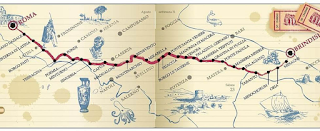
En el centro de Roma, frente a la entrada principal de una conocida agencia de Naciones Unidas y a solo unos pasos de la imponente explanada del Circo Massimo se encuentran las ruinas de lo que fue la Porta Capena. De un fragmento de pared pende una placa de mármol donde a duras penas se puede leer “Inizio Via Appia”.

 
Baúl del Arte: LA VIA APPIA  baulitoadelrte.blogspot.com

La calzada que salía de la Porta Capena no era una carretera cualquiera, más bien la primera y principal. El poeta Estacio la llamó Regina viarum, la reina de los caminos (1). Se empezó a construir en el año 312. a.C. y comunicaba Roma con Capua. Cuando se terminó, en el siglo II a.C., llegaba hasta Brindisi, principal puerto del Adriático. A diferencia de otras vías, estaba empedrada con grandes losas de basalto y su anchura media era de 4,15 m, lo que permitía el paso de 2 carros a la vez circulando en sentido opuesto. Tenía aceras elevadas de tierra batida para peatones, un perfil ligeramente abombado en el centro y vierteaguas a ambos lados para que no se formaran charcos con la lluvia. Unos mojones de piedra llamados miliarios marcaban la distancia en millas (mil pasos dobles) hasta Roma. A lo largo de sus 540 km de recorrido encontramos numerosas tumbas y monumentos funerarios, estaciones de posta para el cambio de caballos y posadas para el descanso de pasajeros - llamadas mansiones -, villas patricias, un teatro y hasta un circo (2).

 
https//:www.enroma.com/appia-antica

Siendo la Via Appia una carretera única, no era la única. Desde Roma partían hacia todos los puntos cardinales muchas más calzadas que, enlazando con otras, cubrían toda la península itálica y conectaban entre si todas las provincias del imperio. Con el tiempo llegaron a formar un entramado tan tupido y extenso que se puede hablar de una verdadera gran Red Transeuropea - veinte siglos antes de que se inventara el concepto -. Roma sería el kilómetro cero de esa inmensa, compleja y eficiente red. Sólo que, en lugar de AP-7, N-340, E-15 o C-32, los nombres de sus principales ejes eran mucho más bonitos: por citar solo algunas, las vías Traiana y Popilia en dirección sur; la Tiburtina hacia el este; Aurelia y Aemilia Scaura rumbo al norte y en dirección nordeste Flaminia y Aemilia. Esta última enlazaba con la Via Iulia Augusta que ya penetraba en la Galia (3).

La red viaria que cubría el imperio de uno a otro confín desempeñaba múltiples funciones: permitía a las legiones romanas desplazarse rápidamente y conquistar nuevos territorios, facilitaba la administración de las provincias, comunicaba centros de población entre sí y con puntos estratégicos, favorecía el comercio y la propagación de la cultura. En el momento de máxima expansión territorial sumaba cientos de miles de kilómetros. Se trata de una obra de infraestructura e ingeniería impresionante con los medios disponibles entonces. Representó un enorme salto cualitativo en la logística de los desplazamientos ya que antes no había nada ni remotamente parecido. Mutatis mutandis, salvando el tiempo y las distancias, esa mejora sería comparable a la facilidad con que hoy cruzamos una ciudad en unos minutos con el metro o nos plantamos a cientos de kilómetros en unas pocas horas gracias a la red de Alta Velocidad.

Nadie ha contribuido a visualizarlo mejor que Alexander Trubetskoy, un estadístico y economista norteamericano de origen ruso, cuya pasión es la cartografía moderna. En 2017 presentó este diagrama de las vías romanas de todo el imperio como si fuera el plano del metro de una urbe moderna. Posteriormente ha hecho lo mismo para cada provincia romana (4).

 
http://sashamaps.net/docs/maps/roman-roads-index

En Hispania la reina de los caminos - por lo menos, en cuanto a longitud y fama - sería la Via Augusta. También llamada Heraclea, arrancaba en los Pirineos donde acababa la Via Domitia y pasaba por Gerunda, Barcino, Tarraco, Saguntum, Valentia, Cartago Nova, Corduba e Hispalis, acabando en Gades. Nada más ni nada menos que 1500 km de recorrido. Un auténtico Corredor del Mediterráneo de la época terminado en tiempo y forma, a diferencia del proyecto actual de casi idéntico trazado (5). La Via Augusta permitía pues ir desde Cádiz hasta la mismísima capital del Imperio cruzando la Galia y sin transbordo ¡hace 2.000 años! Dan fe de ello los famosos Vasos Apolinares o de Vicarello, donde están registradas todas las etapas del itineriario completo, con nombres y distancias, de Gades a Roma (6).

 
Wikipedia, la Enciclopedia Libre

Otras carreteras importantes de Hispania eran la Via Atlántica, muy pegada a la costa lusitana, que unía Onuba (Huelva) con Brigantium (La Coruña); la Via Delapidata que subía en línea recta desde Emerita Augusta (Mérida) hasta Asturica Augusta (Astorga) y la Vía del Norte, que partía de esa ciudad y que era clave para transportar el oro de las minas del Bierzo hasta el puerto de Tarraco.

Los ingenieros que planearon y construyeron esas arterias de comunicación eligieron el mejor emplazamiento posible en cada caso según la orografía del terreno. Por eso no es de extrañar que el trazado de tantas carreteras nacionales y autovías actuales, en España como en otros países europeos, coincida en gran medida con el de las antiguas calzadas romanas. Algunas autopistas están construidas literalmente encima de ellas, con la consiguiente pérdida irreparable de patrimonio.

 
La N-340, antigua Via Augusta, a su paso por el Arco de Bará. 
Desde aquí se tardaba un día en llegar a Tarraco a pie
Hasta los años 1970 la carretera todavía pasaba por debajo del arco (!)

Muchos siglos después de los días de gloria del imperio, la gran red de carreteras romanas no ha desaparecido. Ha sufrido una metamorfosis y está más transitada hoy que en los tiempos del emperador Trajano. A pesar del tiempo y los avatares de la historia, sigue siendo verdad que todos los caminos llevan a Roma.


Notas:
(1) Publio Papinio Estacio, poeta y maestro, s I a.D. Appia longarum teritur regina viarum
    https://www.biografiasyvidas.com/biografia/e/estacio.htm
(2) https://www.imperivm.org/la-via-apia-el-camino-a-roma/; http://www.enroma.com/appia-antica
(3) https://www.romanoimpero.com
(4) http://sashamaps.net/docs/maps/roman-roads-index/
(5) https://elcorredormediterraneo.com
(6) https://es.wikipedia.org/wiki/Vasos_Apolinares#Otras_fuentes_antiguas_para_el_estudio_de_las_calzadas_romanas

Referencias:
https://www.romanoimpero.com
Isaac Moreno: Ingeniería romana - Carreteras, https://www.youtube.com/watch?v=FFFnUM-cG14

Para saber más:
Proyecto Itiner-e, basado en las 3 fuentes clásicas sobre las vía romanas: Itinerario de Antonino, Vasos de Vicarello y Tabula Peutingeriana https://itinere.recerca.iec.cat/

Sunday, November 28, 2021

Interpreters throughout History (part 2)

Por Martha Hobart, AIB

Bas-relief from the tomb of the Egyptian pharaoh Horemheb.
(Image credit: Rijksmuseum van Oudheden, Leiden)

We continue with our overview of interpreters and translators throughout history.

The early modern era

As history continued its long march through the ages, the role of interpreters and translators kept pace with developments. From about the 15th century onward, reference to interpreters in historical documents is common around the globe. It is interesting that much of the earlier documentation referred to “intermediaries”, sometimes distinguishing between “intermediaries” and “interpreters”, while the term “interpreters” gradually became dominant in describing the profession.

We now move into a period of exploration and much movement across the globe. More documentation is also available on many of the better-known interpreters and translators who accompanied expeditions or were found on site at the destinations. There is too much information for this period to go into detail here, so we will list the most outstanding events and personalities here. If any of those mentioned strike the reader’s fancy, an online search will turn up dozens of references, including a fair amount of legend.

Let’s start our journey in Africa.

The Guinea coast,  from the Senegal River to South Angola, was the target of numerous Portuguese expeditions in search of ivory, gold and slaves in the 15th and 16th centuries. The usual method was to capture likely individuals on arrival who could be taken back to Portugal, taught Portuguese and used as interpreters whenever complex situations arose that required more than gestures in exchanging goods.

This was not always successful since there were over 400 languages spoken on the African continent. In such cases, more captives were taken back to Europe to be trained as interpreters.

The Dutch, French and English superseded the Portuguese in the 17th century and adopted their methods. Moreover, the growing British presence in the Americas led to further expansion of trade of all sorts, which extended up to the Sahara desert. Often the most trusted interpreters became guides who assisted the Europeans in local customs and etiquette for meetings with African royalty. Some were so successful in their duties that they became true professionals.

The Ottoman Empire was the scene of a very special group of people who were both interpreters and diplomats: the Dragomans. At its height the empire occupied Central Europe, Crimea, the Middle East and Africa, encompassing a mixed population speaking a variety of languages. Multilingualism and use of a lingua franca largely obviated the need for interpreters, but they were necessary for official purposes when the authorities communicated with their own people and with foreigners. The Dragomans were specially trained to fill this need.

Felix Ordeig wrote about these interpreters and diplomats in an earlier post in our blog.

The Indian subcontinent was another site of intense activity by Europeans.

The French arrived on the subcontinent in the 17th century. They established a settlement called “Puducherry”, which in Tamil means “New Town” and is now known as Pondicherry. Portuguese was a lingua franca in the area and the new arrivals needed interpreters who could communicate in Portuguese with their French employer (the Compagnie des Indes) and in Tamil, Telugu and Persian with their local connections. The Compagnie created a special post and title for the official recruited from the community who represented them and acted for them with local traders and suppliers.

The first “Broker” was Thanappa Mudaliar, who was succeeded by his son, then a young Hindu named Nayiniyappa, and many others throughout the 17th and 18th centuries.

There are accounts of English travelers to the subcontinent on business for the East India Company (EIC) that include references to interpreters, such as that of Sir Thomas Roe, the first royal ambassador to the Mughal Court in the 17th century. He had been preceded by other Company representatives who were not diplomats but merchants and had little knowledge of proper etiquette at high-level meetings.

Roe himself appeared to put his own interests as a diplomat above those of the EIC. His attempts to present himself to the emperor Jahangir and his court were fraught with difficulties and obstacles, owing also to the mix of languages used by all the people involved. He frequently had to work with different interpreters for different interlocutors because of the limitations of his interpreters.

This situation endured in India until the 18th century, when EIC officials made the effort to learn the major languages needed to communicate in this part of the world. Nonetheless, more specialized multilingual brokers and interpreters were still needed to cover situations required by the various levels of communication between Indians and foreigners.

There are accounts of interpreters and translators accompanying diplomatic missions and explorers elsewhere in Asia and the Pacific.

One such interpreter was the Greek adventurer Constantine Phaulkon (also known as Constance). He was born in Cephalonia, largest of the Ionian islands, then under Venetian rule. He left his home at the age of 13, spent ten years in London and then in Java where he worked for the East India Company. Finally, he went to Siam, having been recommended as an interpreter to the minister of foreign trade there. He already spoke English, French, Portuguese, Malay and perhaps Italian and Greek.

Joao Rodrigues was a young Portuguese who accompanied a mission from Lisbon to Nagasaki in Japan and there decided to become a Jesuit priest. He lived in Japan for over 30 years, took his vows, learned Japanese and acted as interpreter at high-level meetings involving the Society and other Portuguese dignitaries visiting Japan.

He was known to the Japanese as “Rodrigues tsuji” (“Rodrigues the Interpreter”).

Captain James Cook’s explorations took him to numerous places in the southern Pacific where he came into contact with local inhabitants and attempted to communicate with them using gestures. Such methods naturally met with limited success and the expedition members were well aware that spoken language would be more useful.

In the course of Cook’s travels around the islands, they came into contact with Tupaia, a member of the ruling circle in Tahiti, a priest dedicated to Oro the god of war, a skilled navigator and highly knowledgeable about the geography of the islands. Tupaia assisted the expedition and eventually joined it on its return voyage to England. However, his health failed him as they visited regions such as modern New Zealand and Australia, and he died along the way. 

Enrique was a Malay speaker who was purchased as a slave by Magellan in Malacca. He was taken to Europe and accompanied Magellan in a meeting with the Privy Council of Seville. He became a trusted interpreter for the explorer and was included in Magellan’s will to be freed and receive a legacy on his master’s death.

Eventually Magellan reached what he thought was the Spice Islands but was actually what was to become the Philippines. Enrique was able to communicate with the island rulers because Malay was the lingua franca used there in diplomacy and trade.

Karma Paul was born in Lhasa in Tibet and raised by missionaries in Darjeeling after he was orphaned. He became fluent in English, Nepali and Tibetan and worked as a schoolmaster in Darjeeling and in an office in Calcutta.

When the British Himalayan Expedition was organized in 1922, its leader, General Charles G. Bruce, engaged Karma Paul as interpreter. More than merely linguistic concerns, Karma Paul was also of great assistance in smoothing relations between the British and the local population.

He was a man of two worlds: Karma the Buddhist and Paul the Christian.

The Americas

Centuries of travel between different regions of the world for exploration, trade and diplomacy had made it clear that linguistic assistance was essential for cross-cultural communication, and expeditions set out with interpreters versed in the languages that would most likely be needed.

Christopher Columbus’s experience was very different when he set sail for what he thought would be India. His expedition included Luis de Torres, a Jewish convert to Christianity who knew Hebrew, Chaldean and some Arabic, languages that were commonly used in the known world of the time. As we well know, his voyage ended in a place totally unknown to Europeans and his interpreter was of little use.

Columbus took several Caribbean people on his return to Spain from that first voyage with the intention of having them baptized and teaching them Spanish so they could interpret on subsequent voyages. Only one of them, known as Diego Colón, actually became an interpreter, but he was not of much help because the natives of the Caribbean did not share a language. It was not until his fourth voyage that Columbus succeeded in training a captive Caribbean native, known as Juan Pérez. Diego Colón, nonetheless, continued as an interpreter and was able to assist the Europeans in their exploration of the islands around Hispaniola and in making contacting with the Taíno people in Cuba. His own language was similar to that of the natives of this area.

There were other native people who were trained as interpreters but some of them ran away and many died. Apart from the European illnesses that killed many natives, Columbus’s own attitudes toward the natives and his refusal to accept that he had not reached Asia may have led to his difficulties in communication.

The 16th century was a period of numerous voyages of exploration and conquest from Europe to the Americas, and further discovery of the vastness of these lands. Plus the multitude of languages spoken there, which made communication a complicated enterprise.

The approach of these explorers tended to be improvisation. Sometimes they captured natives at one location and kept them on board as they traveled to others and took them back to Spain to learn Spanish, on the assumption that these captives would be able to understand the people the Spaniards encountered elsewhere.

But this was far from successful. Francisco Hernández de Córdoba led an expedition with some Cuban natives on board when he reached the Yucatan peninsula. However, the Maya language had no relation to the Taíno spoken by the Cubans. Hernández therefore took two local men, known as Melchor and Julián, with him when he left Yucatán, but this plan was also foiled. Melchor was a fisherman with limited knowledge of Mayan. Julián returned to Yucatán on a future expedition led by Juan de Grijalva; but because he was a Yucatec Maya, he was unable to communicate with the Chontal Maya speakers in northern Yucatán.

Grijalva resorted to the usual solution and seized four more natives to be trained as interpreters. One was renamed Pedro Barba. He spoke both Yucatec Maya and Chontal Maya, which made it possible to set up what we now know as a relay system: Grijalva spoke Spanish to Julián who interpreted in Yucatec Maya to Pedro who transmitted the message in Chontal Maya.

Gerónimo de Aguilar was a Spanish Franciscan friar sent to Panama as a missionary. He was shipwrecked on the Yucatán Peninsula and made his life among the Chontal Maya. When he heard of Cortés’s arrival in Yucatán Aguilar went to join him and helped out in his dealings with the local people.

Cortés soon acquired a second interpreter who was among the twenty women given him by a Chontal Maya leader. Her Christian name was Marina and she came to be known as La Malinche. She had the advantage over Aguilar in that she was the child of Nahuatl speakers and was bilingual in Nahuatl and Chontal Maya. Lourdes Ramírez told us her story earlier in the AIB blog.

England was also active in this New World but focused more on North America. There are accounts of the role of interpreters in attempts by England to establish colonies along the southeastern coast in what is now the United States. Some were of European origin who had acquired knowledge of local languages and others were native Americans.

Manteo was a werowance, or chief, of the Croatan tribe that lived on an island off the coast of modern North Carolina. He was taken to England along with Wanchese from Roanoke Island by an exploratory expedition to the area where the Roanoke colony was later founded.

The two men, both Algonquian speakers, were taught English and later accompanied the second expedition to Roanoke. Wanchese refused to collaborate with the Englishmen but Manteo acted as interpreter for the expedition’s leader, assisting in negotiations for establishing a colony on the island. The Algonquians made life impossible for the settlers and within a short time all but 15 of them returned to England with Sir Francis Drake, along with Manteo and two other natives. Manteo returned a year later with the governor John White, to find that all of those left behind, including Wanchese, had disappeared. White sought revenge and Manteo was involved in the fighting.

A second colony was founded and Manteo was given the dubious title of Lord of Roanoke. White returned to England for supplies but was unable to deliver them until three years later, only to discover that once again all the settlers, including Manteo, had vanished.

We end our tale with the Lewis and Clark expedition in the early 19th century, which lasted two years and covered some 13,000 km from St. Louis, Missouri, to the Pacific coast.

By this time there was a sizable population of people of mixed French-Canadian and native American descent around Camp Dubois in present-day Illinois where the expedition spent the winter. They were familiar with the Plains tribes and were hired for various duties, including interpreters who became vital intermediaries for Lewis and Clark.

George Drouillard was one of them. He was the son of a Frenchman settled in Canada and a Shawnee Nation woman and spoke English, French and Shawnee. He was also proficient in the Plains Indian Sign Language.

Lewis in The Journals of Lewis and Clark remarks that at first he thought this was a series of gesticulations among the tribes of the area. It was later learned it was a complete language that was actually a lingua franca among the peoples of the Plains from the Gulf of Mexico to Calgary, Canada. Drouillard was hired to interpret Lewis and Clark into Indian Sign Language and Native Americans into English.

Several more interpreters later joined the expedition. To quote Christine Adams in her article published in the “Interpreter Zero” series:

Cruzatte, along with François Labiche enlisted in May 1804; both of them were part Omaha.  In October 1804, we have Joseph Gravelines, described as “well-versed in the language of this [Arikari] nation.” A Frenchman, René Jusseaume, who had made his life with an Indian woman, was taken on as a temporary interpreter for Mandan in October 1804, when the expedition was at its winter quarters in Fort Mandan, in present-day North Dakota. Entries after November of that year refer to “our Minetaree interpreter”: Toussaint Charbonneau, a French-Canadian trapper who joined the expedition along with one of his two wives, Sacagawea.

There is much uncertainty and legend about Sacagawea and her life. A native speaker of Hidatsa, she also knew Shoshone. Her husband Charbonneau spoke the language of the Aaniiih Nation and Hidatsa.

She is not mentioned often in the expedition journals but in 1902 was immortalized by novelist and feminist Eva Emery Dye in her book The Conquest: The True Story of Lewis and Clark. How this young Northern Shoshone woman became a legend in North American history is a fascinating story in itself.

More details on Sacagawea at: https://en.wikipedia.org/wiki/Sacagawea

Eva Emery Dye’s depiction of Sacagawea is rather fanciful and is considered to be the origin of the myth surrounding her. Many scholars agree that the author used the young Native American as a role model for later generations of women and a symbol of pioneer motherhood.
See: https://www.oregonencyclopedia.org/articles/dye_eva_emery/

And finally, a student of the University of Puget Sound wrote an interesting thesis that explores the creation of the Sacagawea legend: https://soundideas.pugetsound.edu/cgi/viewcontent.cgi?article=1004&context=honors_program_theses

Friday, November 26, 2021

Interpreters throughout History (part 1)

by Martha Hobart, AIB

Bas-relief from the tomb of the Egyptian pharaoh Horemheb. 
(Image credit: Rijksmuseum van Oudheden, Leiden)

The story of interpreters around the world through the ages is a fascinating thread that runs through history since ancient times. It is far too lengthy and complex to go into detail here so I will just give an overview and encourage you to look deeper into the practitioners of our profession who came before us.

In spite of my intentions, the “overview” became longer that I had expected, so I will post it in two parts. The history of interpreting and translating is a long one.

You can find much more in the impressive series of articles published on the AIIC website by Christine Adams starting in 2012 and still ongoing at its new home, Looking for Interpreter Zero. It was a major source of information for this article.

Interpreters in the Bible and ancient Egypt

Human groupings have been in contact with one another since the beginning of the historical record and long before. Indeed, interpreting is likely as old as language.

Interpreters have been present since biblical times, in the story of Joseph, who was sold into slavery in Egypt by his jealous brothers. He was eventually freed and became vizier to the Pharaoh.

When the Israelites’ harvest failed, the brothers travelled to Egypt to buy grain. There they encountered Joseph although they did not recognize him. However, Joseph recognized them and understood the conversation between the brothers, but spoke with them through an interpreter, as was customary in Egyptian trade relations.

In Genesis 42:23 we find this passage: “[The brothers] did not realize that Joseph understood them, since there was an interpreter between them.”

Trade was an important part of Egyptian life, as were diplomacy and captive taking, much of which was related to Egypt’s dealings in Africa and the Middle East. To this end, the ancient Egyptian bureaucracy included what they called “interlingual mediators”. Some of the earliest evidence of these interpreting practices comes from the tombs of the princes of the island of Elephantine, which date from the third millennium BCE. Their titles included “secret advisor of the southern lands of Upper Egypt” in reference to the location of the island on the border between Egypt and Nubia.

Communication with their non-Egyptian subjects and contacts was the responsibility of interpreters, whose duties were not limited to linguistic mediation but were more wide-ranging in their contacts with foreigners.

The importance of these linguistic mediators is immortalized in a bas-relief in the tomb of the pharaoh Horemheb, dating from the 14th century BCE (see the image at the top of this post). It shows an interpreter (in the middle) mediating between Horemheb (left) and foreign envoys (right). In this case the interpreter is depicted as if there were two individuals, while other archeological discoveries portray interpreters as having two heads.

Greece and Rome

Herodotus in his Histories speaks of the need for language intermediaries in ancient Greece. There was extensive contact between Greece and Egypt and there were Greek-speaking communities in Egypt. They were even entrusted by the Pharaoh Psammetichus with the teaching of the Greek language to certain Egyptian children, who subsequently became the parents of the entire class of interpreters in Egypt.

Although interpreters were essential in Greece, they were sometimes thought of as being treacherous. Herodotus recounts an incident during the Persian wars in which the Persian king Darius sent messengers to several Greek cities to demand earth and water as tokens of their submission to him. According to Herodotus, the messengers and the interpreter who accompanied them were thrown into a well to take the earth and water themselves. Plutarch, in his account, held the Athenian statesman and general Themistocles responsible for such treatment of “treacherous intermediaries” who dared to use the Greek language in the service of non-Greeks.

The Romans treated interpreters differently, perhaps because their empire covered a vast amount of territory that included many different languages. Interpreters were essential in the Senate since most of the ambassadors from far-flung territories did not speak Latin.

But interpreters are rarely mentioned in documentary sources, perhaps because they were simply taken for granted, or their presence was ignored by officials who mastered other languages but preferred to speak in Latin to mark the prestige of Latin. Even from its early days, Rome was surrounded by peoples who spoke different languages or Latin dialects; as the empire expanded to other nations, the need for linguistic assistance became greater.

Cicero’s letters and Julius Caesar’s The Conquest of Gaul often mention interpreters, especially in the Senate. They also commonly appear in contexts other than formal meetings and oratory. The term interpres included roles such as messenger, mediator, envoy or military adjuvant.

There are mentions of a few individuals who were sent by Caesar to replace what he called “ordinary interpreters” because he felt more the need for other skills in addition to language in particularly delicate situations.

The Middle Ages

The known world continued expanding and became more and more complex, as evidenced in documented accounts of the activities of interpreters after the Norman conquest in 1066. Prior to this period there is little information available.

One early event stands out: the Strasbourg Oaths of 842. The Frankish historian Nithard gives an account of three rivals for power in Carolingian Europe who competed for power in the 9th century. Charles the Bald and Louis the German fought against Lothar and won but Lothar would not concede defeat. After a bloody battle and much loss of life, Charles and Louis felt the need to ensure their followers’ loyalty in the lengthy war that was to follow. They gathered their forces in Strasbourg to renew their alliance in a highly structured event that became known as the Strasbourg Oaths.

It is not known exactly how the linguistic aspects were managed in the proceedings but what stands out is the recognition by all parties for absolute clarity in communication. Charles spoke to Louis the German’s men in Old High German (or Frankish) and Louis in regional Romance (or Proto French) to address Charles’s followers. The texts of the each lord’s oath were preserved in Nithard’s Historiae, which has survived until today.

If you are interested in details you can find more here.

The need for interpreters is rarely mentioned in accounts of the Norman Conquest but the linguistic situation in Britain at the time was already complex. English, Welsh, British, Scandanavian, Pictish, Scottish, Cornish and some Irish were spoken, while the clergy used vernacular and Latin. To this was added French by the Normans.

Old English literature gives clear evidence of professional interpreters who acted as intermediaries and translators between all the different linguistic groups. Because of the exclusive nature of their work, they were given a special name: Wealhstod.

Other records speak of latinarius (a corruption of “Latiner” which meant “interpreter”) and interpres.

The Byzantine Empire was another multilingual area characterized by sometimes fraught relations with surrounding peoples. It was a land that depended heavily on mercenaries in its military ventures and had a large immigrant community. Communicating with strangers was part of the structure of Byzantium. There was a body of interpreters who interpreted at diplomatic meetings and translated correspondence into and out of Greek. There were Nordic, Turkish and Frank contingents in the imperial army, plus guards, who needed intermediaries. Likewise, many foreigners served in the fleet that protected Constantinople and the naval bases in the Adriatic and Ionian Seas, whose commanders needed linguistic assistance.

Byzantium was constantly threatened by depredations and conquest by numerous peoples on all sides. The emperor Alexios I Komnenos was open to foreigners and willing to engage in diplomacy throughout his reign, in addition to dealing with the split between the eastern and western churches and conspiracies against Alexios in Constantinople. All this required the assistance of translators and interpreters.

After the death of Malik-Shah, Sultan of the Seljuk Empire, who had been his close ally, Alexios sent an embassy to Pope Urban II to appeal for Christian solidarity, cleverly focused on ways in which the Pope could help him rally support for the victims of Muslim incursions into the Holy Lands in a broad sense. Thus began the Crusades.

In western Europe the dominant group were the Latin Christians. Educated Christians used Latin and in this part of the world regional languages and dialects coexisted with elite vernaculars; the fighting men were divided into regional contingents with shared languages. There was no apparent need for interpreters as linguistic difficulties could be overcome by other means.

However, the elite Crusaders were accompanied by rank-and-file fighters who were peasants or townspeople who had never had need of communication outside their locality. Furthermore, when tensions arose between leaders, there was a natural tendency to support one’s own linguistic group. Much stress was laid on common purpose but this could be outweighed by regional affiliation and individual ambition.

It was during the siege of Antioch when the Latin Crusaders joined forces with the Byzantines. Alexios I had provided intermediaries for them but the stresses of the prolonged siege and the negotiations that followed the fall of the city made it necessary to find people who could communicate in the various languages involved.

The ultimate destination of the Crusaders was Jerusalem and along the way they recruited Christian intermediaries to negotiate with local Muslim rulers. They were also assisted by these impromptu interpreters during the siege of Jerusalem.

The Caliphate of Córdoba on the Iberian Peninsula was another scene of multilingual activity. The Umayyad Caliph of Cordoba, Abd ar-Rahman, worked extensively with intermediaries, who were mostly Jews or Christians, in the tangle of hostilities and alliances between Muslins and Christians in the politics of al-Andalus and the Christian kingdoms on the Iberian Peninsula and elsewhere.

The most common languages used in these exchanges were Hebrew, Arabic, Andalusi Romance (the dialect descended from Late Latin) and Latin. But now and then other languages were involved. On one occasion a delegation from Constantinople presented Abd ar-Rahman with a copy of a work on the medicinal properties of plants, On Medicine, by Dioscorides. It was written in Greek, which no one could read, so the Caliph appealed to Byzantium for help. A Greek monk was dispatched to translate the text, with the assistance of a Greek-speaker from Sicily who also spoke Arabic.

After the fall of the Córdoba Caliphate there was a period of some two centuries in which culture and politics were in constant flux as succeeding rulers ascended and fell, until by the mid-thirteenth century only the Muslim kingdom of Granada remained, along with a few Muslim communities in the Christian kingdoms. Throughout the entire period of Muslim, Jewish and Christian coexistence on the Iberian Peninsula, there was an ongoing demand for translators, interpreters and intermediaries, and today we have a legacy of many words of Arabic origin in the Spanish language.


Part 2 of this series will cover what is generally described as the early modern era and take us up into the 20th century.

Saturday, October 30, 2021

Traducción a la vista

Por Guiomar Stampa, AIB

Traducción a la vista,
Sight Translation,
Stegreifübersetzung,
Traduction à vue

Que levante la mano quien no se haya visto en una cabina, con un folio delante, haciendo una TAV a toda velocidad mientras el orador va leyendo su discurso a la velocidad de la luz, eso sí, con sus paréntesis, saltos, chascarrillos añadidos y una entonación que no coincide con lo que mandan los signos de puntuación que vemos en el papel.

Y si, además, nuestro orador lee su discurso en una lengua que no es la suya, tenemos un buen cisco armado.

En esas situaciones esta intérprete hace su trabajo lo mejor que puede, con la sensación de ir subida a espaldas del orador con la lengua fuera, intentando que no se me oiga demasiado la respiración cuando cojo aire para no ahogarme.

Una TAV es una traducción a la vista. Puede ser una traducción a primera vista, en la que no se ha visto antes el texto, puede ser una traducción a la vista preparada, en la que se ha podido leer el texto con tiempo para prepararlo, puede ser una traducción a la vista en interpretación consecutiva o una simultánea con texto. (Hurtado Albir: Jiménez Ivars, 2003).

La que describo más arriba es la simultánea con texto. El intérprete reformula el discurso oral que escucha con apoyo del texto que lee el orador. En el mejor de los casos habrá recibido el texto con antelación suficiente y se encontrará ante un orador que lee a ritmo pausado y con una buena entonación. En el peor, le habrán llevado el texto a cabina unos instantes antes de la intervención y se encontrará ante un orador que lee a toda velocidad y con una entonación que no respeta las pausas de la puntuación.

En ambos casos el texto será de gran ayuda en la interpretación de las cifras y los nombres propios.

Todo esto viene a colación, porque creo que en la formación de intérpretes la TAV desempeña un papel muy importante en las diferentes fases de la adquisición de las técnicas de interpretación, especialmente de la simultánea.

Las socias de AIB que formamos intérpretes en distintas universidades recurrimos a esta modalidad de traducción-interpretación en nuestras aulas.

En una primera fase ayuda al estudiante a resolver los posibles problemas de traducción (terminología, estructura) antes de enfrentarse a un discurso oral sobre el mismo tema.

En una segunda fase, una TAV sin preparación, reformulando el texto sin pausas a medida que se lee, ayudará al estudiante a desarrollar estrategias similares a las que necesitará en cabina con el discurso oral. Es el caso de la anticipación del verbo en alemán al interpretar al español. También es una gran aliada a la hora de generar los famosos automatismos, como el famoso last but not least, y, por último, aunque no por ello menos importante.

En una última fase, ayudará a gestionar mejor en cabina la situación descrita al principio. Claro que los ejercicios de simultánea con texto deben introducirse una vez dominadas las diferentes técnicas que necesitamos en cabina. Con una progresión adecuada en cuanto a dificultad del discurso escrito, la velocidad de lectura y la entonación.

Hay que aprender a hacerlo, la realidad en nuestro trabajo es así. Oradores que leen, mejor o peor, con texto en cabina o sin él. Si dominamos la técnica de la TAV, resultará algo más llevadero.

Tengo la impresión de que con la interpretación a distancia o interpretación remota el discurso leído es una tendencia que irá a más.

Eso sí, yo prefiero, sin duda, a los oradores espontáneos que dominan el tema y que hablan con pasión de lo suyo.

Estoy segura de que los escuchantes también.

Sunday, September 26, 2021

La intérprete de conferencias en otoño de pandemia

Por Pilar García Crecente, AIB

¿Os cuesta la vuelta al trabajo tras las vacaciones estivales? ¿Habéis notado alguna diferencia entre el retorno antes de la dichosa pandemia y ahora? A mí me está costando quizá más que el verano pasado. Me cuesta concentrarme, me noto cansada y algo falta de energía, leo hasta altas horas porque me cuesta conciliar el sueño, tengo la sensación de que este arranque de otoño, que se presenta movidito, ¡se me hace cuesta arriba!

Yo no sé si estoy sufriendo el llamado síndrome o estrés postvacacional o si lo que tengo es cansancio consecuencia de la pandemia, la verdad.

Leyendo sobre esta cuestión, me he encontrado con un consejo de la psicóloga Mireia Navarro en que nos dice: fíjate en lo bueno, te sentirás afortunado por lo que ya tienes y centrará tu mente en lo positivo. Desde luego puede ayudar, porque efectivamente cuantas más vueltas le damos a nuestros sentimientos negativos peor nos sentimos, así que ¡a quitar de en medio el mal rollo! y a llenar la mente de lo bueno que sí tenemos.

Antes, en los viejos tiempos no creo haber tenido nunca el llamado síndrome o estrés postvacacional, en realidad regresaba a un ritmo de vida que me encantaba, a una profesión que me apasionaba y no me costaba nada reincorporarme. Vuelta a comprar billetes, a reservar hoteles y hacer maletas, vuelta a estudiar y a preparar reuniones y vuelta ilusionada a coincidir con los compañeros en cenas estupendas después del trabajo, y vuelta a las clases y a una nueva promoción de jóvenes estudiantes ansiosos por conocer la interpretación. Mi adaptación solía ser rápida y feliz, o así la recuerdo ahora…

Y después llegó la pandemia….

El final del verano de 2020, en plena pandemia, tras un durísimo confinamiento, traía consigo la gran pregunta de ¿Seguirá el parón? ¿Acabará de una vez esta situación, ya no debería prolongarse mucho más…? ¿Trabajaremos algo? ¿Cuánto podremos aguantar? Nos daba igual cómo, ¡necesitábamos trabajar como fuese! Así que el alivio fue enorme cuando constatamos que toda la preparación y aprendizaje al que nos dedicamos en los arduos meses de sequía extrema daban sus frutos. Nuestros estimados y fieles clientes confiaron en nosotros y en la tecnología, y juntos nos pusimos en marcha para hacer de las reuniones en línea nuestro pan de cada día. Y así pudimos ir enderezando nuestras cuentas bancarias mínimamente y seguir pagando la hipoteca o el alquiler.

El final de este verano de 2021 ha venido acompañado del hartazgo: ¡esta historia de la COVID 19 no se acaba nunca! Las medidas cambian de un día para otro, viajar no se parece a lo que era, tenemos unas ganas inmensas de ver a los compañeros y a la vez sentimos inquietud y nos preguntamos si nos sentiremos seguros o no en un congreso con multitud de gente o incluso en un avión… Reina cierta incertidumbre ¿no?

Incertidumbre porque el cliente no acaba de saber si su reunión podrá ser presencial, si a los intérpretes nos quiere in situ o no, porque ya vemos la luz al final del túnel pero no nos atrevemos a creérnoslo y, en mi caso, cierto desasosiego porque no tengo claro si me apetece viajar o no, si depende del destino o de la duración del contrato, ¿cambiarán las medidas mientras estoy de viaje? ¿Y si me encuentro mal por allá y tengo que quedarme? Ansío recuperar el terreno conocido pero a la vez me embarga la inquietud porque lo percibo incierto.

No estoy sola, afortunadamente parece que no me pasa solo a mí, mal de muchos… Si alguno de vosotros también se ve reflejado en lo que cuento, a ver si poniendo en práctica algunos consejos de los que nos proporciona el Colegio de Psicología de Madrid al final de este artículo conseguimos estar al cien por cien cuanto antes.

¡Feliz otoño!